Rocacorba Climb: Girona's most Famous Ascent
Nine point eight kilometres every Girona rider talks about: the numbers, the hard kilometres, three ways up and a full day from the city.
Quick links
Don't want to read all this?
We've planned 800+ cycling trips. Send your dates, fitness and group size — we'll map the route and book every night.


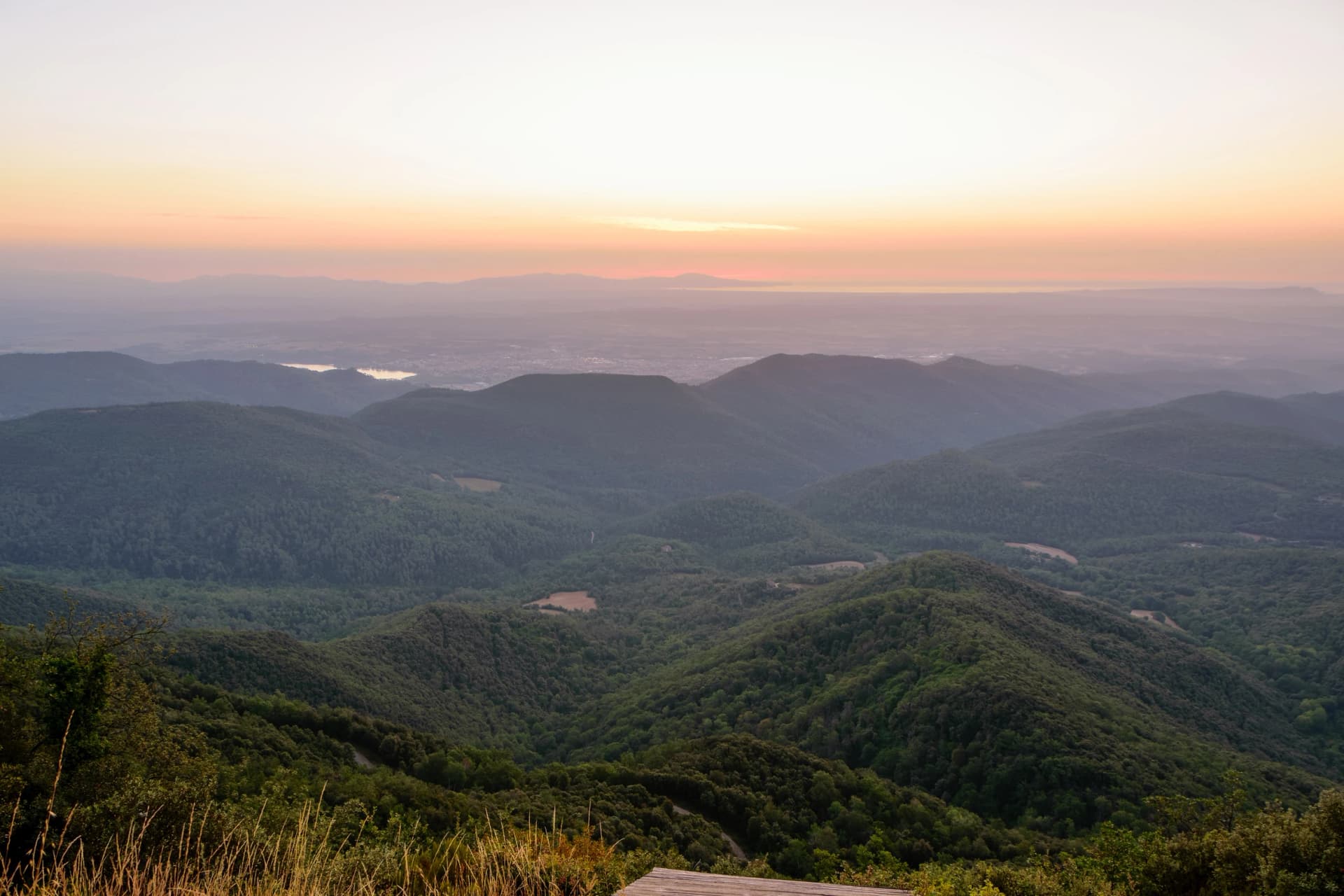
Rocacorba is the climb cyclists in Girona measure themselves against. The road starts on the western edge of Banyoles, 20 km north of the city, and ends at a barrier under the masts of Puigsou, at 991 m the highest point of the Gironès. Nothing else is up there: no village, no café, no fountain, just a metal gate, a sign for the photo and a view that reaches the Pyrenees one way and the sea the other.
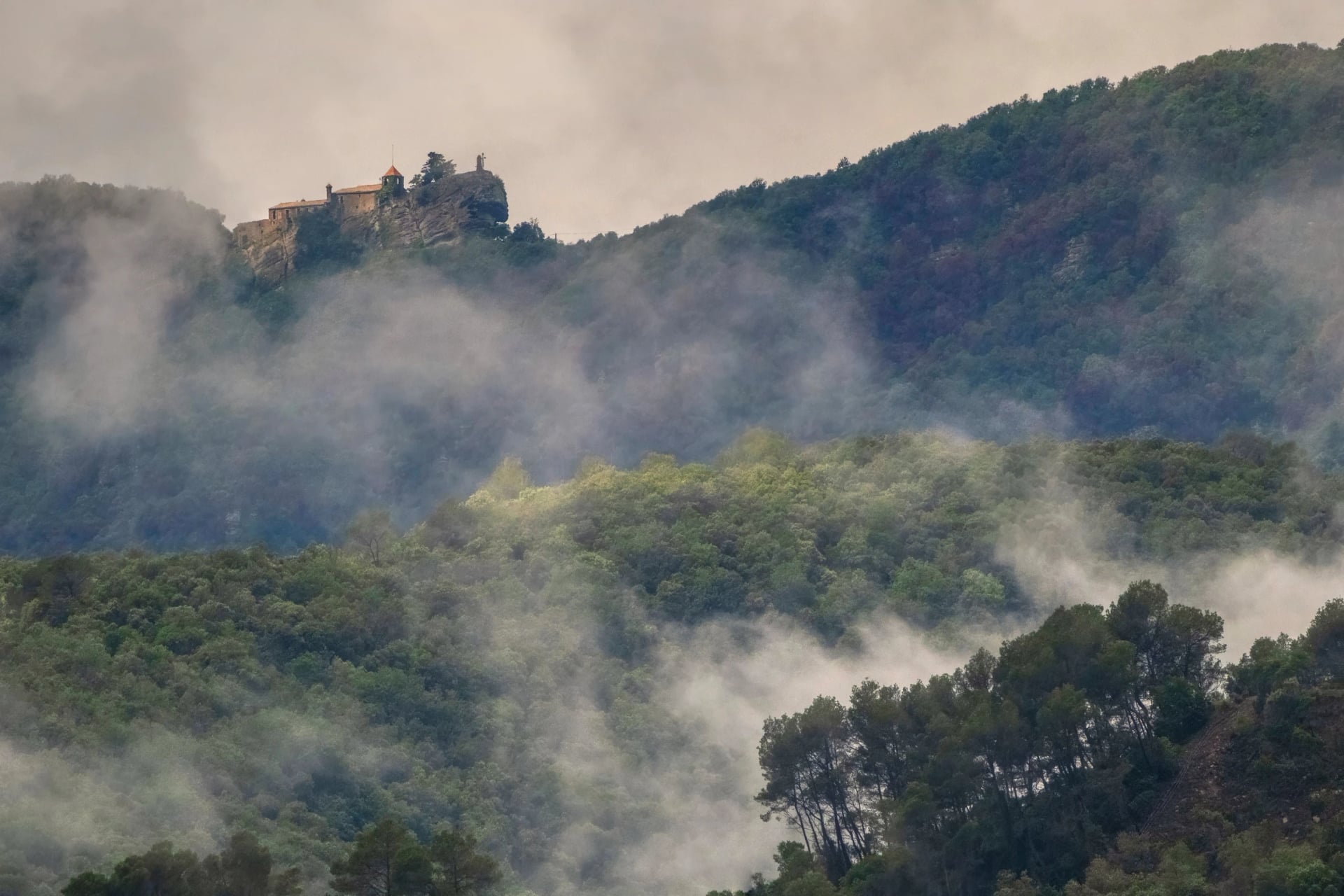
The mountain has history. The sanctuary of Santa Maria de Rocacorba, on a crag at 929 m just below the masts, has been documented since 1065, and in the 1790s the summit was one of the survey points used to measure the Paris meridian and fix the length of the metre. The road to the top was only fully paved in 2006; since then the climb has become the test piece of the professionals who live in Girona, and the Strava segment counts close to 88,000 attempts. Riders come for the profile as much as the view: a long warm-up, a false flat that lulls you, then two kilometres that bite.
The climb in numbers
Measured from the Strava segment "Alt de Rocacorba", which starts at the stone bridge where the GIV-5247 crosses the Matamors stream below Pujarnol, west of Banyoles, and ends at the summit barrier.
Length: 9.8 km from the bridge to the barrier
Elevation gain: 744 m, from 240 m to 967 m
Average gradient: 7.4 % over the whole climb
Steepest 100 metres: 13.3 %, at km 5.9
Steepest kilometre: 11.1 %, between km 5 and km 6
Category 1; the record is 26 minutes 20 seconds, a fit amateur takes 45 to 70
From the lake in Banyoles: 14.8 km and 808 m, if you start the clock at the lakeside cafés
Other sites start the clock in Banyoles town or on the lake road, which is why they quote 14 km at 5.6 % or 12.3 km at 6.4 %. The climbfinder profile of Rocacorba is the 12.3 km version and worth opening for its gradient-coloured profile, 37 rider photos and a calculator that turns your climbing speed into a time. The Alt de Rocacorba segment on Strava is the 9.8 km climb proper, the one the locals race.
We suggest starting your watch at the green pin on this map, the stone bridge below Pujarnol, where the 9.8 km segment the locals race begins.
Rocacorba section by section
Km 0 to 3: the riverside warm-up
The road follows the Matamors valley in the shade and climbs past the hamlet of Pujarnol. A steady 6 % for three kilometres, with one short kick to 9 % near km 1.8. This is the part everyone rides too hard.
Km 3 to 4: the false flat
Under 2 %, and for a few hundred metres the road even descends. The only recovery on the whole climb: drink, drop the pace, and do not be fooled by it.

Km 4 to 6: the hard kilometres
Two kilometres at 10.9 % that never dip below 8 %. The ramps touch 12 and 13 %, the road narrows and the surface gets rougher. This is where the climb earns its name.
Km 6 to 8: sustained
Still 8 to 10 %, with no respite for two kilometres. The trees thin and you start to see the Pla de l'Estany below.
Km 8 to the top: a breather, then the ramp to the tower
Half a kilometre that is almost flat, then the last 1.3 km averages 10 % to the barrier under the masts. Eleven hairpins in all. The sign for the photo is at the gate; the sanctuary is on its crag just below you.
How hard is Rocacorba?
Hard, but not out of reach for a fit self-guided rider. If you can ride 60 km with 1,000 m of climbing and feel fine the next day, you will get up Rocacorba. Expect about an hour of climbing at a steady effort; the pros do it in under thirty minutes, most visitors take 50 to 70.
What makes it harder than its 7.4 % average suggests is the shape. The gradient keeps changing, so you never settle into a rhythm, and the two steep kilometres come after 25 minutes of climbing, when the warm-up has already cost you something. A compact chainset with a 32 or 34 sprocket turns the hard part from a grind into a climb. On an e-bike the gradient is not the issue, battery is: leave with a full charge and save the highest assist mode for kilometres 4 to 8.
Three ways up
1. The road from Banyoles, the classic
The climb every ride report describes and the one the segment measures. 14.8 km and 808 m from the lake to the barrier, 9.8 km of it the climb proper. Leave the lake on the GIV-5247 heading west; the climb starts at the stone bridge below Pujarnol. Tarmac all the way, patched and rough in the steep middle, and almost no traffic because the road is a dead end.
2. The gravel side from Canet d'Adri
From Canet d'Adri, south of the mountain, a tarmac lane climbs 5 km and 220 m through Adri to the hamlet of Biert, where the Camí de Biert turns to gravel: 5.3 km at 10 % with ramps over 20 %, concrete on the switchback corners, joining the road about 1.5 km below the top. A gravel-bike climb with its own Strava segment, "Ascens Rocacorba", and a fraction of the road's company: 6,500 attempts against 88,000.
3. The long way from Girona
31 km and 1,100 m from the old town to the summit, almost all on tarmac, out to Banyoles and then up. Out and back it is 62 km with about 1,300 m of climbing, a proper day; the next section lays it out stop by stop.
A Rocacorba day from Girona
A full day that needs no car and no transfer. Start by nine from May to September; in winter, leave late enough for the sun to reach the top.
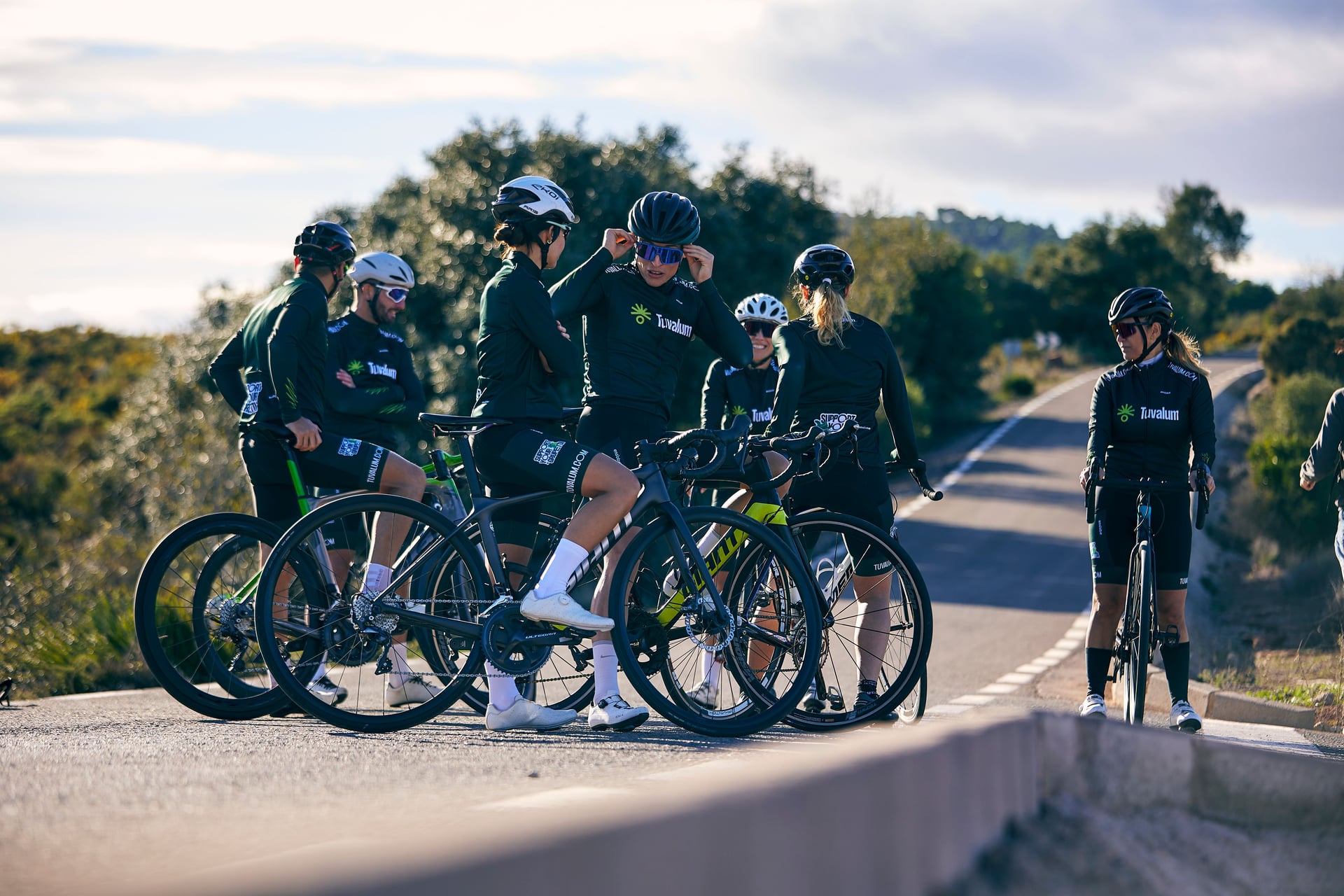
Girona to Banyoles, 16 to 20 km depending on the lanes: cross the Ter and take the back roads through Medinyà and Cornellà del Terri rather than the main road, flat to rolling, an hour at a touring pace.
Coffee and water at the lake: Banys Vells, the bar on the lakeshore, is the usual stop, and the cafés under the arcades of Banyoles' Plaça Major are the alternative. Fill both bottles here, because there is no water on the climb and nothing at the top.
The climb, 14.8 km from the lake: the GIV-5247 west, the stone bridge over the Matamors, Pujarnol, then the five sections above. Budget an hour from the bridge.
The summit: the gate, the masts, the sign, and on a clear day a view from Cap de Creus to the Puigmal. Put a layer on before you roll.
The descent: the same road, narrow, patched, with blind corners in the steep middle. Brake early, keep your weight back, and never descend Rocacorba on wet tarmac; every local says the same.
Home: a second coffee at the lake, then the lanes back to Girona. 62 km and 1,300 m door to door, four to six hours with the stops.
Staying in Banyoles or Serinyà instead? From Serinyà it is 10 km to the foot of the climb through Banyoles, so an out-and-back to the summit is about 40 km.

When to ride Rocacorba?
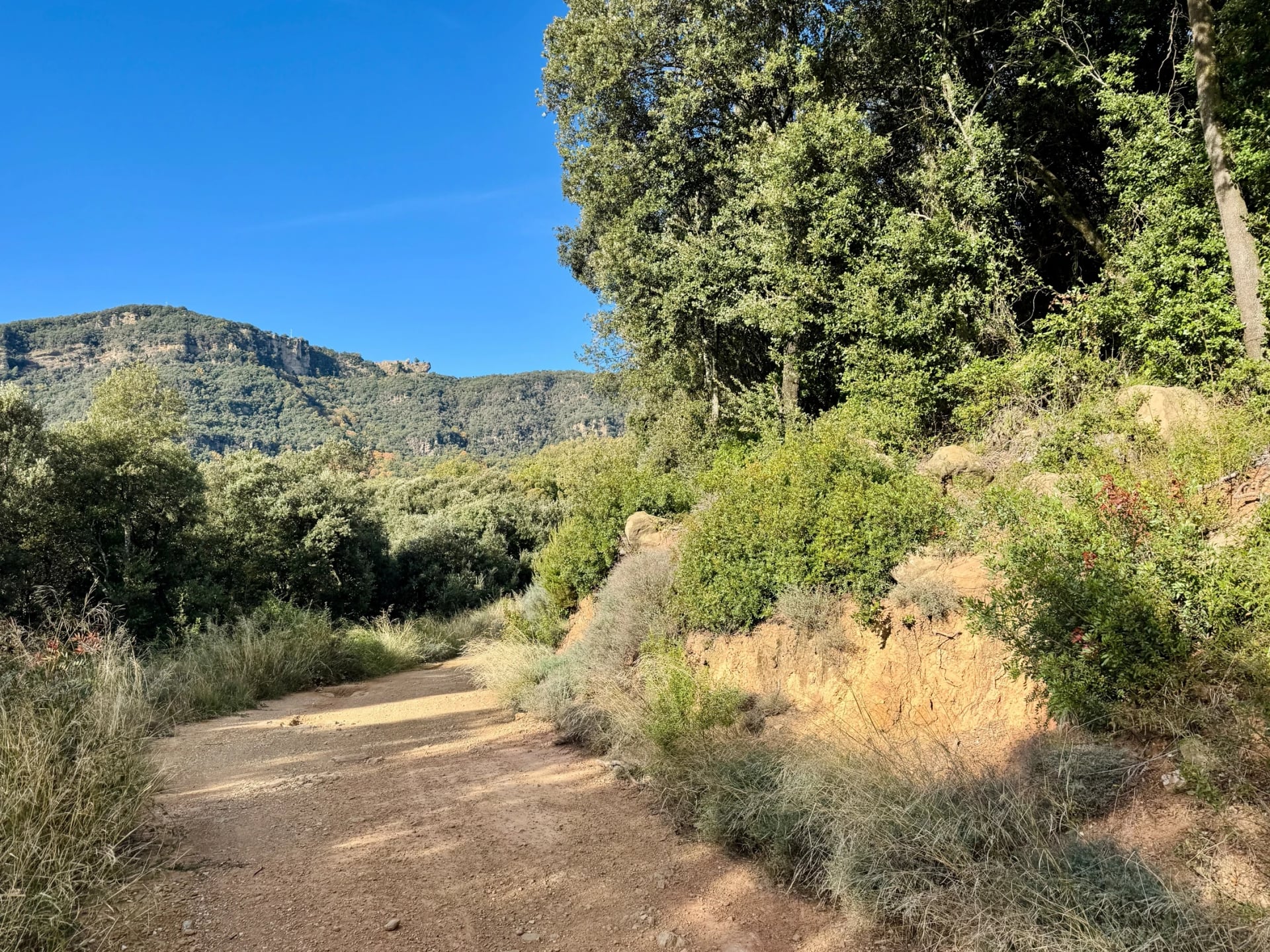
Rocacorba is open all year, but not comfortable all year. The valley figures below are the climate normals for Girona airport; the summit runs about 5 °C cooler than Banyoles, and nothing stops the wind up there.
Spring, March to May: the best window. Valley highs of 17 to 22 °C, full streams, green woods. April and May have the most rain days of the year, seven a month, so pick your day with the forecast and give a wet road a day to dry.
Summer, June to August: early or not at all. Highs around 30 °C in July and August, and the lower kilometres are an oven by late morning. Be at the bridge by nine. August brings the most thunderstorm days, five on average, mostly in the afternoon.
Autumn, September to November: the second window, and the quietest. 26 °C in September, 22 in October, 17 in November. October is the wettest month of the year, 88 mm, so take the dry days between the fronts.
Winter, December to February: possible, with care. Clear skies and valley highs around 13 °C, but frost on 10 to 13 mornings a month down in the valley, and the top can ice while Banyoles is dry. The climb rarely sees snow. Ride it in the early afternoon.
Whatever the month, the summit is the coldest point of the ride on a windy day: pack a layer for the descent. Check the yr.no forecast for Banyoles the evening before, hour by hour with wind and rain, and take the dry day.
Other Girona climbs worth your legs
Els Àngels
The one every Girona ride seems to pass. 14.5 km from the old town to the sanctuary with 443 m of climbing, nothing over 8 %, and a bar at the top. The easy day, or the warm-up before Rocacorba.
Mare de Déu del Mont
The long one. From Besalú the road climbs 22 km and close to 1,000 m to the sanctuary at 1,120 m, about 4.5 % on average and steeper in the last two kilometres; from Girona the round trip is 115 km with about 1,800 m of climbing. Quiet roads, open views near the top, a narrow descent.
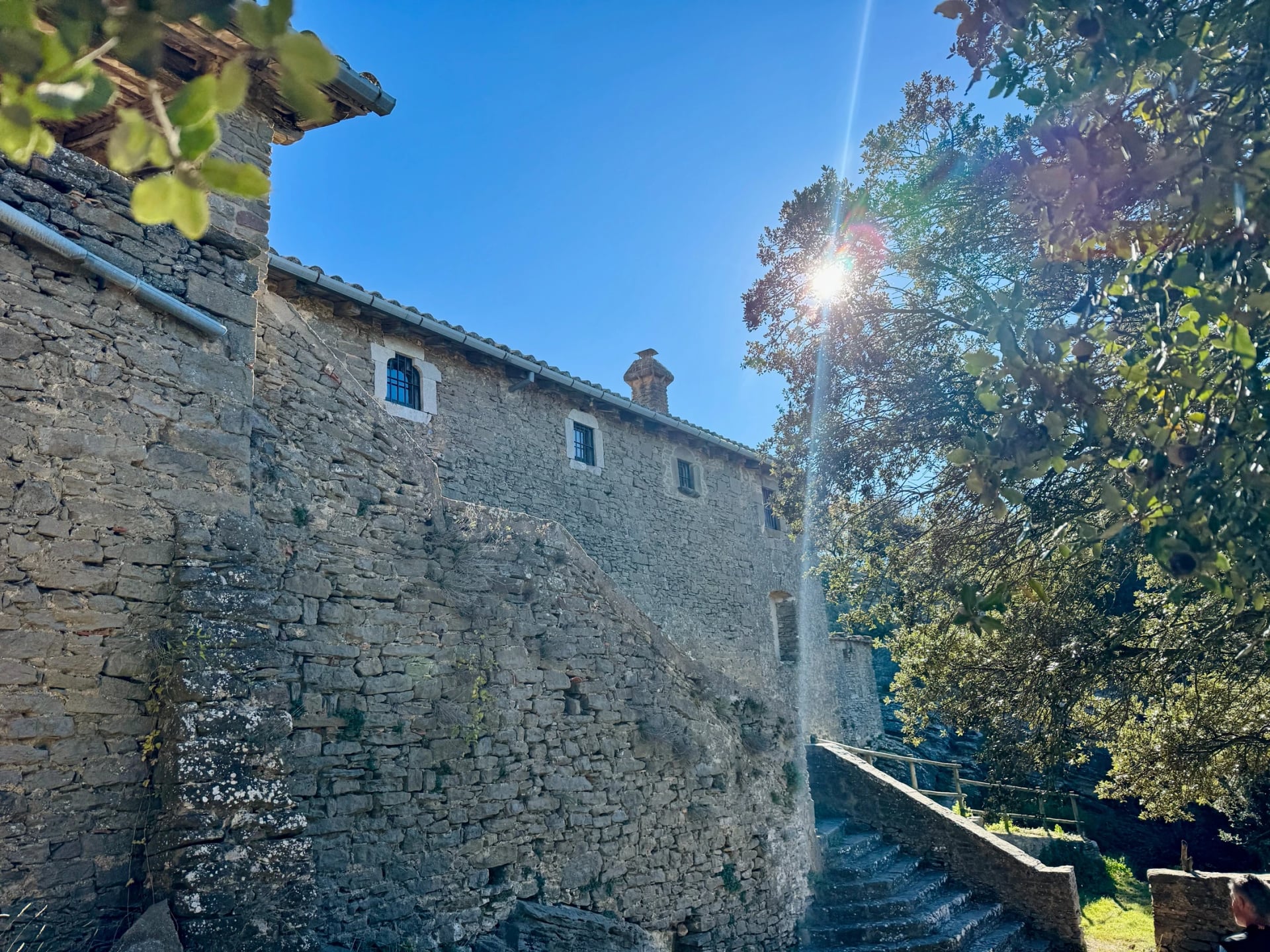
Sant Grau d'Ardenya
The coast climb, above Llagostera and Tossa de Mar: 13.3 km and 379 m from Llagostera to the sanctuary, usually ridden as part of the Costa Brava loop to Tossa.
Sant Hilari Sacalm
A spa town at 800 m in the Guilleries south-west of the city. The road from Anglès gains around 650 m at a gradient that lets you talk, and cafés wait at the top, which Rocacorba cannot say.
All four, with the routes that link them, are in our Girona cycling guide.
Where to stay for the climb
Girona's old town makes Rocacorba the centrepiece of a 60 km day and puts the cafés at the end of it; Banyoles or Serinyà put the foot of the climb within 10 km of your door and suit a shorter day. What matters is safe bike storage, a workshop corner and a breakfast that starts early; the hotels we book for our Girona tours are on our cycling hotels in Girona page.
Which of our tours ride Rocacorba
The Girona Gravel Cycling Holidays tour saves it for its last riding day: from Besalú you ride gravel tracks and back roads to Banyoles, take the road climb to Rocacorba and descend along the Ter valley into Girona, a day of 84 km and 1,600 m of climbing. A road climb on a gravel bike, and the wider tyres are welcome on the patched tarmac of the steep middle and on the descent.
The Girona & Costa Brava Cycling Highlights loop sleeps its first nights in Serinyà, 10 km from the foot of the climb, and its Banyoles day has shorter and longer options. Rocacorba is not on the printed routes, but riders who want it can add it from Serinyà as an out-and-back of about 40 km on the Banyoles day.
For the tours, the seasons and the logistics of riding here, see our Girona cycling holidays page.
If you would rather have the week arranged, we recommend Girona Gravel for the climb itself, and Girona & Costa Brava Cycling Highlights if you want to add it on the Banyoles day.
Questions riders ask about Rocacorba
How hard is Rocacorba?
Harder than its average says. 9.8 km at 7.4 % with two kilometres above 10 % and a gradient that never settles; a fit rider needs about an hour, the record is 26 minutes.
How long is the Rocacorba climb?
It depends where you start the clock:
9.8 km and 744 m from the stone bridge west of Banyoles, the Strava segment
14.8 km and 808 m from the lake in Banyoles
31 km and 1,100 m from Girona's old town
Is there water or a café at the top?
No. Nothing is sold or poured above Banyoles. Carry two bottles from May to September and plan the coffee for the lake on the way down.
Can I ride Rocacorba on a gravel bike or an e-bike?
Both. The road is tarmac to the gate, so a gravel bike climbs it without fuss, and the gravel side from Canet d'Adri is a gravel bike's own way up, with ramps over 20 %. On an e-bike start with a full battery: the loop from Girona is 62 km with 1,300 m of climbing, and the steep middle in top assist mode is where the charge goes.
When is the best time to ride Rocacorba?
Spring and autumn on a dry day.
In summer be on the climb before nine; in winter wait for the early afternoon, because the summit ices while the valley stays dry. Rain in the last 24 hours is a reason to ride Els Àngels instead.
Can I add Rocacorba to one of your tours?
Yes. The Girona Gravel tour already rides it on its last riding day, and the Girona & Costa Brava loop stays in Serinyà, close enough for a 40 km out-and-back on its Banyoles day. Tell us what you have in mind when you send an inquiry.



Plan with a cycling expert
Free advice from a team that knows these routes inside out - real people, not a bot

Hassle-Free
We take care of route planning, accommodations, luggage transfers, and all logistics, so you can focus purely on enjoying your ride.

Tried & Tested Adventures
Our cycling routes are hand-picked & tested, to ensure breathtaking landscapes, smooth roads, and maximum safety - giving you the perfect ride every day.

Unbeatable Support
Our 24/7 customer support is where we show our passion, ensuring your cycling holiday runs smoothly and your well-being is always our top priority.

Book with Confidence
We are a financially protected company, fully bonded and insured, keeping your money safe and allowing you to travel with confidence.

